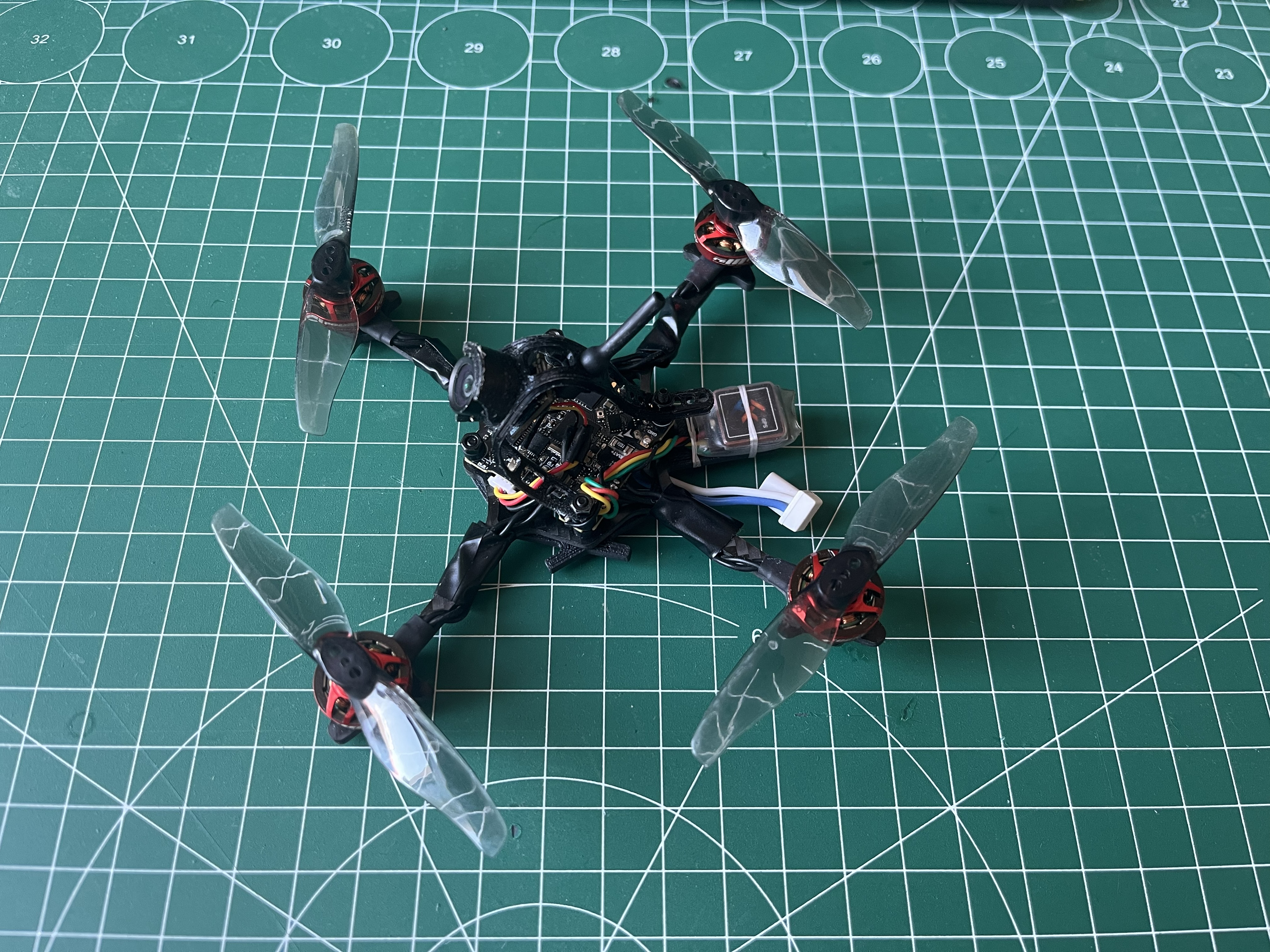
Building a 3″ 1S Toothpick FPV Drone
For my first ‘proper’ FPV drone, after previously only flying pre-built tiny whoop drones, I decided to build a 3" 1S Toothpick FPV drone.
The name ‘3" toothpick’ usually referes to a quadcopter drone that combines 3 inch propellers with a light weight FC and frame, powered by a tiny 1S battery. This type of drone is in something of a sweetspot - the large propellers and light weight allow for long flight times, a low noise profile and less kinetic energy than larger builds, which enables flight in places where larger drones would be unsafe or draw too much attention. For me, it was also very nice as it allows me to reuse the batteries of my Betafpv Air75. In the future, I may also fly with a 18650 lithium ion battery, which could allow for flight times of up to 20min!
Here are the parts used:
- Happymodel X12 5in1 1-2S flight controller
- RCINPower 1202.5 11500KV motors
- Caddx Ant Nano camera
- Crux3 frame
- Gemfan Hurricane 3018 3" 2-blade propeller
Takeoff weight with the battery is about 54g.

Changing the Camera to a BetaFPV CO3
After some initial testing I was not very happy with my Caddx Ant Nano - the image quality is noticeably worse than what I am used to from my BetaFPV Air65 and Air75. This worse image quality has the effect of making me much less confident while flying, so I decided to install a BetaFPV CO3 on it. So far, I am really happy with it! The TPU canopy is also much more durable than the old one, so that is an another benefit.



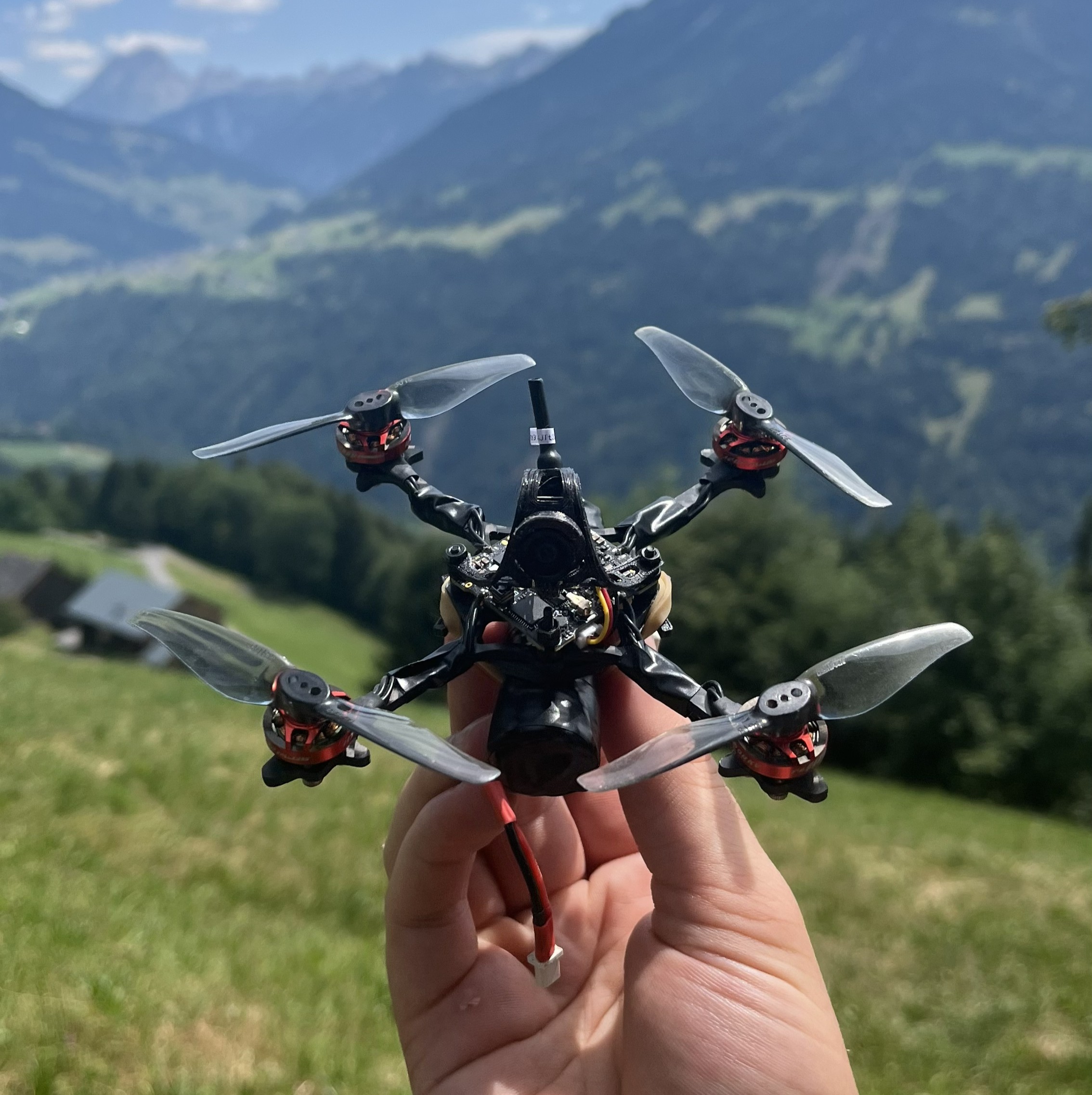
18650 Li-Ion Battery
18650 Li-Ion batteries are widely used in many types of electronics, from electric scooters to laptops. They have a significantly higher energy density than Li-Po batteries of the same weight, though they offer a lower discharge rate. This makes them unsuited for freestyle and acrobatic maneuvers that require lots of sudden power, but absolutely perfect for long-range cruising.
A 3" toothpick drone can just about carry a single 18650 cell, which can push its endurance beyond 20 minutes.
I chose the Molicel INR18650-P28A 2800mAh for its high 35A discharge rate. Fortunately, I was able to order the batteries with pre-soldered tabs. This meant I didn’t have to solder the power wires directly to the battery casing, which can be highly dangerous. The complete build with this battery comes in at about 92g - still safely sub-100g. On my first flight, I achieved a flight time of about 17 minutes while discharging the battery to 3.1V. Because Li-Ion batteries can safely be discharged even further, I could probably push past the 20-minute mark next time.


GPS Module
Now that my drone has significantly increased range and endurance with the 18650 battery, the next step is naturally to install a GPS module. This allows me to configure GPS Rescue, where the drone can return automatically if the connection to the pilot is lost. My hope is that this will increase my confidence when trying to fly some “long range” in the mountains, where going behind a cliff can mean completely loosing all signal. I decided to go for the FlyfishRC M10 Mini, as it is tiny, weighing just 2.4g and thus helping to keep the total weight below 100g.
Mounting the GPS module on a drone as tiny as this can be a challenge - you want to get it as far away from the ELRS and VTX antenna as possible as to minimize any interference. Additionally, we want to mount it with a clear view of the sky, to get as many satellites as possible. I decided to go for a configuration where the GPS is is mounted at the back of drone on a small 3D printed extension. You can find the STL here.